
You Can’t Secure What You Can’t See: Why Observability Is the Missing Layer in AI Systems
As AI systems evolve from simple retrieval pipelines into agentic, multi-step workflows, the challenge is no longer just building them — it’s understanding what they are actually doing in production. Most teams still rely on traditional logs and surface-level metrics, which might work for deterministic systems but fall short in AI environments. When a response is incorrect, unsafe, or unexpectedly expensive, the root cause is rarely obvious. It could stem from retrieval, prompt construction, tool usage, or memory interactions. Without deeper visibility, teams are left guessing.
This becomes even more critical as systems gain autonomy. Agentic architectures introduce decision-making loops, tool invocation, and dynamic behavior that can’t be easily predicted. As a result, failure modes become harder to detect and even harder to reproduce. Agentic systems don’t just increase attack surface — they make attacks harder to detect. Observability is no longer optional; it’s a security requirement. If a system retrieves poisoned data, misuses a tool, or leaks sensitive information, the absence of traceability means these issues can persist unnoticed until they cause real damage.
What’s missing is the ability to trace how the system arrived at a given outcome. This is where platforms like LangSmith, Langfuse, Braintrust and some others come into play. Instead of treating the model as a black box, they allow teams to inspect the full execution path — from input to intermediate steps to final output. You can see which documents were retrieved, how prompts were constructed, which tools were called, and how decisions evolved across steps. This level of visibility turns opaque system behavior into something you can analyze, debug, and improve.
But observability is not just about debugging — it’s about control. Once you can trace execution, you can start evaluating it systematically: Was the right data retrieved? Did the system follow the expected reasoning path? Were guardrails respected? Over time, this enables teams to move from reactive fixes to proactive quality and risk management. Instead of waiting for failures to surface, you can detect anomalies, enforce constraints, and continuously validate system behavior against defined expectations.
Ultimately, production AI systems require a shift in mindset. It’s not enough to optimize outputs — you need to understand the process that produces them. If you can’t trace it, you can’t debug it. If you can’t debug it, you can’t trust it in production. Observability bridges that gap. It transforms AI systems from unpredictable black boxes into manageable, inspectable systems — and that’s a prerequisite not just for scale, but for security and trust.
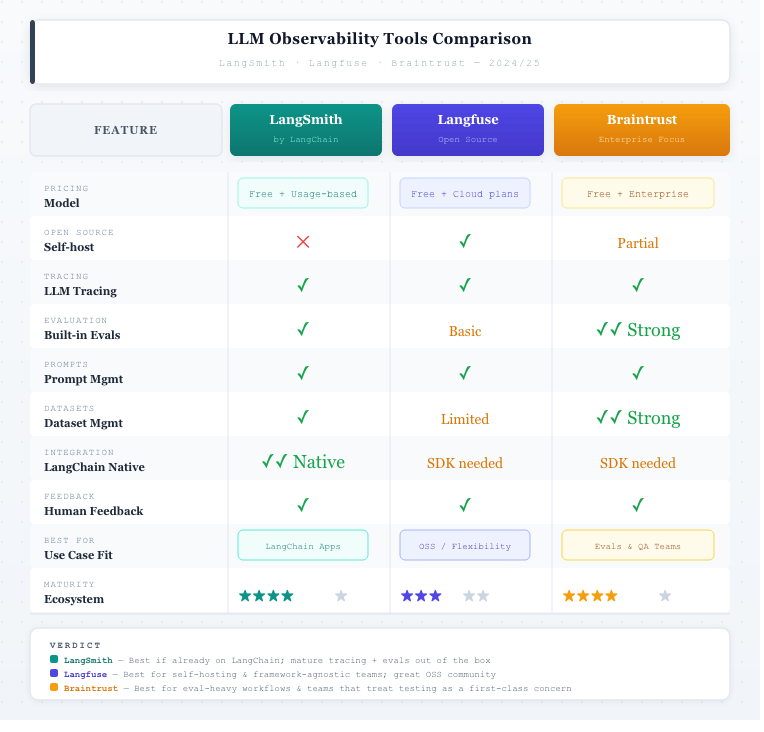
Observability tools comparison
Reference: Tools comparison - https://langfuse.com/faq/all/langsmith-alternative