
AI Program Management: Why Technical Excellence Isn’t Enough
Most AI systems don’t fail because of poor models. They fail because the surrounding system — people, processes, and decisions — isn’t designed to handle uncertainty. Teams often focus heavily on model quality, infrastructure, and performance benchmarks, assuming that technical excellence will naturally translate into successful outcomes. In reality, production AI systems introduce ambiguity at every layer: shifting requirements, evolving data, and unpredictable behavior. Without strong program management, even technically sound systems struggle to deliver consistent value.
One of the biggest challenges in AI delivery is that scope is inherently unstable. Unlike traditional software, where requirements can be defined and incrementally delivered, AI systems evolve as teams learn from data and user behavior. Stakeholders frequently change expectations midstream — what started as a simple retrieval system becomes an agent with tool access, memory, and decision-making capabilities. This isn’t scope creep in the traditional sense; it’s a reflection of uncertainty. The role of program management is not to eliminate this change, but to contain and guide it without derailing timelines or overloading teams.
Another critical gap is misalignment across functions. Engineering teams optimize for model performance and system reliability, product teams focus on user experience, and leadership often expects immediate business impact. In AI systems, these priorities don’t always align. A model improvement might increase latency or cost. A product feature might introduce new security risks. Without a clear framework for trade-offs, teams end up optimizing locally while the overall system suffers. Effective AI program management creates alignment by defining shared success metrics — not just accuracy, but reliability, cost efficiency, and controllability.
What makes this even more complex is that AI systems are not fully deterministic. They may look deterministic in parts, but behave non-deterministically as systems. You can’t always predict how the system will behave in production, especially as it interacts with real users and external data. This makes traditional delivery models insufficient. Instead of fixed roadmaps, teams need adaptive planning, continuous evaluation, and strong observability into system behavior. Program managers play a key role in establishing feedback loops — ensuring that insights from production inform both technical improvements and product decisions.
The teams that succeed with AI aren’t just building better models — they’re building better systems around them. That means treating AI delivery as a cross-functional, continuously evolving program rather than a one-time project. Technical excellence is necessary, but it’s not sufficient. The real advantage comes from the ability to manage uncertainty, align teams, and maintain control as systems become more autonomous. In that sense, AI program management isn’t just coordination — it’s a core capability for turning experimentation into production reality.
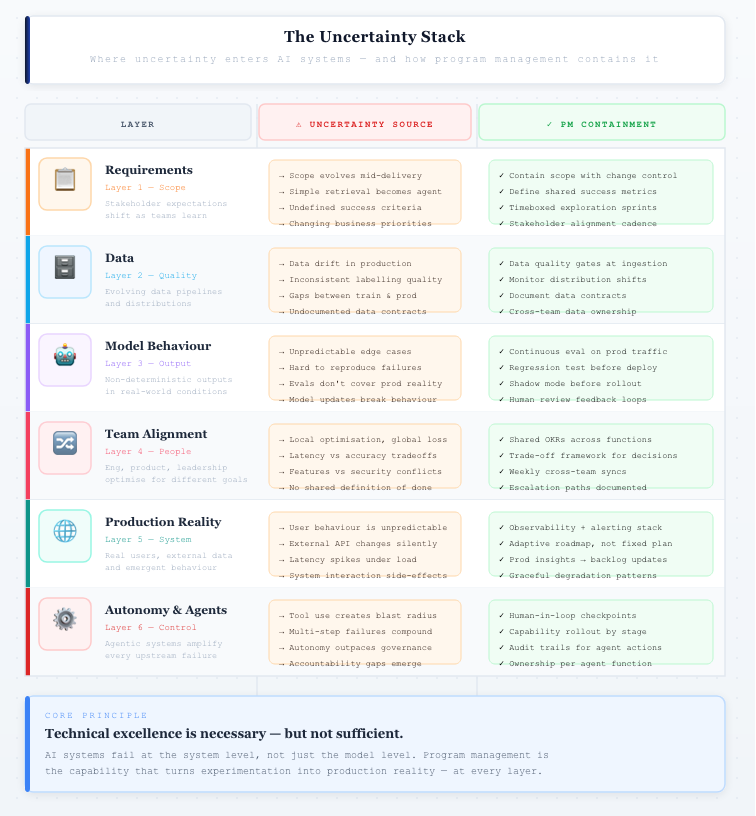
The Uncertainty Stack