
When Observability Stops Being a Tool Choice and Becomes an Architecture Choice
In my previous article, When AI Observability Becomes Compliance Infrastructure, I argued that observability is evolving from a debugging capability into a foundational requirement for governance, auditability, and trust.
Recently, I instrumented the same Agentic RAG application with both LangSmith and Langfuse to better understand what observability looks like in practice.
The goal was not to determine which platform is "better."
The goal was to understand how different observability approaches shape the way we operate AI systems.
What I discovered is that the most important difference between observability platforms is not their dashboards, user interfaces, or individual features.
The most important difference is what role observability plays in the overall architecture.
The Same System, Two Observability Models
The application itself remained unchanged.
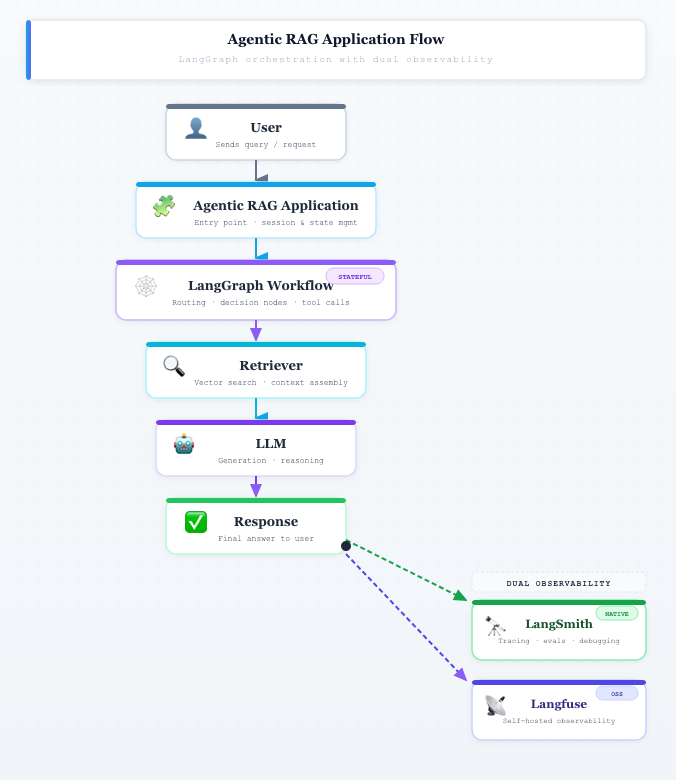
The LangGraph node has a "stateful" badge to highlight its role in agentic orchestration
The same workflows executed.
The same prompts were submitted.
The same retrieval pipeline operated.
The same model generated responses.
Both platforms observed the same underlying system.
Yet they encouraged slightly different ways of thinking about observability.
One emphasized developer productivity and rapid debugging.
The other emphasized ownership, flexibility, and operational control.
Both perspectives proved valuable.
What LangSmith Does Exceptionally Well
The first thing that stood out was how quickly LangSmith provided useful visibility into the system.
Key strengths include:
Fast setup
Excellent workflow visualization
Strong LangChain and LangGraph integration
Minimal configuration
Intuitive debugging experience
The trace views consistently made it easier to understand what happened inside a workflow and where failures occurred.
When investigating retrieval quality issues, prompt behavior, or agent execution paths, the ability to inspect individual steps significantly reduced troubleshooting time.
The overall experience feels optimized for helping developers understand system behavior as quickly as possible.
That is particularly valuable when building and iterating on complex AI workflows.
What Langfuse Does Differently
While Langfuse provides many of the same observability capabilities, the platform feels different in practice.
Several characteristics stood out:
Open-source architecture
Self-hosting capabilities
Data ownership
Export flexibility
Vendor independence
One observation that emerged during implementation was that Langfuse felt less like a service being consumed and more like infrastructure being operated.
That distinction may seem subtle initially, but it becomes increasingly relevant as AI systems move beyond experimentation and into environments with governance, compliance, or data residency requirements.
Questions begin to emerge that extend beyond debugging:
Where are observability records stored?
Who owns those records?
How long are they retained?
Can they be exported?
Can they remain within a particular jurisdiction?
Those questions are architectural rather than operational.
The Trade-Off That is Less Discussed
Many product comparisons focus on features.
My experience suggested a different comparison.
The most important trade-off is not interface versus interface.
It is convenience versus control.
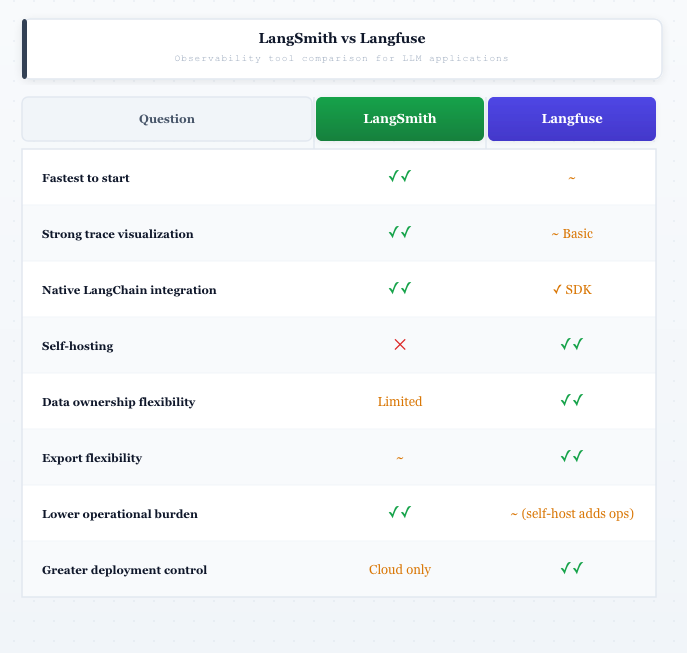
Neither approach is inherently better.
The choice depends on what problem an organization is trying to solve.
Teams focused on rapid experimentation may prioritize simplicity and ease of adoption.
Organizations operating under stricter governance requirements may place greater value on ownership and deployment flexibility.
Both represent valid architectural choices.
What Changed My Thinking
Before implementing both platforms, I primarily viewed observability as a developer tool.
The objective was straightforward:
Understand failures faster
Improve debugging efficiency
Increase development velocity
After instrumenting the same system with both LangSmith and Langfuse, my perspective changed.
I began viewing observability as an architectural layer.
The question is no longer:
"Which interface do I prefer?"
The more interesting question is:
"Who owns the operational data generated by my AI system?"
That single question influences decisions around governance, compliance, security, retention, portability, and long-term operational strategy.
It also changes how observability fits into the overall system design.
Conclusion
One of the most interesting outcomes of implementing both platforms was realizing that observability is no longer a single capability.
Tracing remains important.
Debugging remains important.
Developer productivity remains important.
But as AI systems become more deeply integrated into business processes, observability begins serving additional purposes: governance, accountability, operational control, and trust.
LangSmith and Langfuse both provide valuable visibility into AI workflows.
What differs is not simply how they present information, but how they position observability within the architecture.
My initial goal was to compare two observability platforms.
The larger lesson was that observability is increasingly becoming an architectural decision.
As AI systems mature, organizations may find themselves spending less time asking which tool they prefer and more time asking what level of ownership and control they need over the operational data their systems generate.