
Using AI to Optimize an Agentic RAG Platform: Why Local Validation Still Matters
In my previous articles, I explored how observability supports AI security, governance, and compliance. While continuing development of my Agentic RAG platform, I found myself applying many of those same principles during development. This time, however, the focus wasn't on production observability—it was on improving the engineering feedback loop itself.
The feature I was working on was my Evaluation pipeline. As I expanded evaluation capabilities, latency became the biggest obstacle to rapid iteration. Faster evaluations meant faster experimentation, shorter development cycles, and more opportunities to validate improvements before moving on to the next feature.
Rather than treating AI as an automatic code generator, I approached it as an engineering collaborator. I asked it to analyze bottlenecks, suggest targeted optimizations, explain the reasoning behind each recommendation, and propose alternatives where appropriate. The quality of the suggestions was impressive. Several changes significantly reduced latency, simplified portions of the implementation, and improved the overall responsiveness of the evaluation workflow. Two images below show latency before and after improvements.
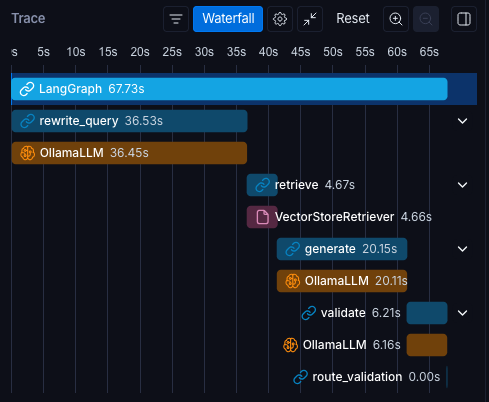
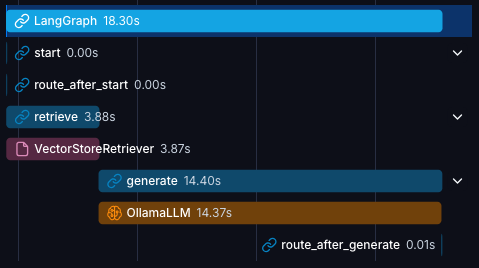
The biggest lesson, however, wasn't about AI's ability to optimize code—it was about the importance of validating every optimization locally.
At a recent Codex Meetup in San Francisco, I had an interesting conversation with an engineer from Reddit. During our discussion, he mentioned that he didn't have a local environment for validating AI-generated changes before committing them. That conversation stayed with me because my experience had been quite different. Several optimizations suggested by AI appeared perfectly reasonable during review, but only local execution revealed whether they actually delivered the expected improvements. In a few cases, I discovered regressions, subtle behavioral differences, or optimizations that simply didn't produce meaningful performance gains. Those findings would have been difficult to identify through code review alone.
That experience gradually evolved into a repeatable engineering workflow. Every optimization began with measuring the existing bottleneck, followed by targeted AI-assisted suggestions, incremental implementation, local validation, latency benchmarking, and a full evaluation run before any code was committed. The AI dramatically accelerated the optimization process, but measurement and validation remained essential parts of the engineering discipline.
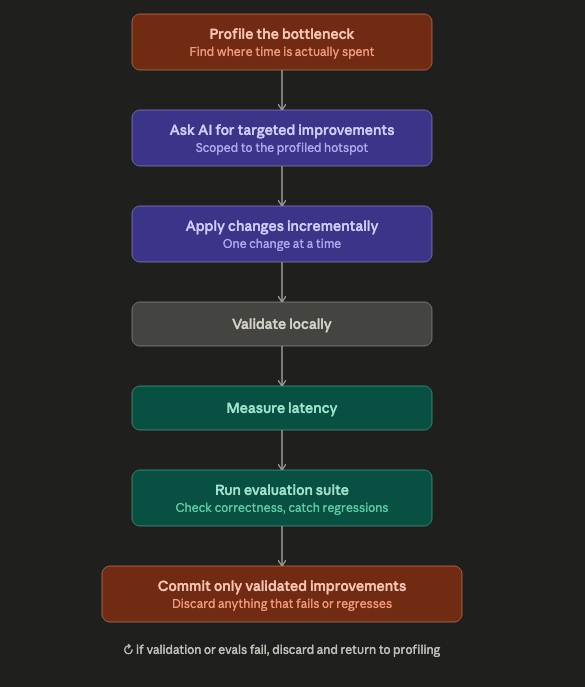
Human-Validated AI Development Cycle
One unexpected realization was how closely this mirrors the principles behind AI observability. In production, we rely on traces, evaluations, and monitoring to verify how AI systems behave under real workloads. During development, local validation serves a similar purpose—it provides objective evidence that a proposed change actually improves the system rather than simply appearing to do so. Whether validating an LLM response or an AI-generated code change, evidence consistently proves more valuable than assumptions.
This experience reinforced an important lesson for me: AI coding assistants are becoming exceptional implementation partners, but they don't eliminate the need for engineering rigor. They generate ideas, accelerate experimentation, and often uncover optimizations that might otherwise be overlooked. It is still the responsibility of the engineer to measure, validate, benchmark, and confirm that those improvements hold up in practice.
As AI becomes a regular part of software development, I believe the most effective teams won't be those that rely on AI the most—they'll be the ones that build disciplined workflows around it. In my experience, combining AI-assisted development with local validation, repeatable measurements, and continuous evaluation produces far better outcomes than either approach alone.