
LangChain vs. LlamaIndex in RAG context
LangChain and LlamaIndex are two of the most widely used frameworks for building Retrieval-Augmented Generation (RAG) systems, but they serve different roles within the pipeline. LangChain provides a comprehensive toolkit for orchestrating the entire RAG workflow—retrieval, prompt construction, tool integrations, agents, and post-processing—while LlamaIndex focuses more deeply on data ingestion, indexing, and retrieval quality. In a typical RAG setup, LangChain functions as the “application orchestrator,” whereas LlamaIndex serves as the “data engine” responsible for building a highly optimized knowledge base.
In the data preparation and indexing stage, LlamaIndex offers advanced features for chunking, metadata extraction, document hierarchies, and hybrid or graph-based index structures. This makes it exceptionally strong when the quality of retrieved information depends on how the knowledge base is constructed. LangChain also supports document loading and embedding, but LlamaIndex is built specifically to give developers fine-grained control over how data is transformed into vector indexes. These indexing-centric capabilities make LlamaIndex especially effective for improving RAG retrieval relevance and precision.
When orchestrating the live retrieval and generation process, LangChain provides greater flexibility and modularity. It excels at building multi-step chains, coordinating multiple retrievers, calling external tools or APIs, routing queries, and composing different prompts. This makes LangChain a strong choice for complex RAG applications that require logic flows, evaluation loops, or agent-style reasoning. While LlamaIndex also supports retrieval pipelines and query engines, its primary focus is ensuring that the data is structured and accessible rather than orchestrating multi-step decision workflows.
Both frameworks integrate seamlessly with modern vector databases, including ChromaDB. ChromaDB is a popular choice for storing embeddings due to its open-source nature, high performance, and flexible metadata filtering. In LangChain, ChromaDB can be plugged in with just a few lines of code as a VectorStore, allowing LangChain chains and agents to retrieve relevant documents efficiently. LlamaIndex also supports ChromaDB as a storage backend, enabling developers to use LlamaIndex’s powerful indexing and query abstractions on top of the same vector database. This means teams can use ChromaDB as a shared, persistent vector layer regardless of whether the orchestration is done through LangChain, LlamaIndex, or a combination of both.
In production RAG deployments, LangChain and LlamaIndex often work side-by-side, and ChromaDB acts as a reliable vector storage layer for both. LlamaIndex can handle the data ingestion, embedding, and index construction, storing vectors inside ChromaDB. LangChain can then use that same ChromaDB instance to retrieve relevant chunks during runtime, build prompts, and drive multi-step reasoning flows. The result is a flexible, scalable, and high-quality RAG system: LlamaIndex optimizes the data and indexing layer, LangChain manages orchestration and logic, and ChromaDB provides a shared high-speed vector store that both can rely on.
LangChain Expression Language (LCEL)
LangChain Expression Language (LCEL) is a declarative way to build LLM-powered pipelines using simple, chainable components. Instead of writing complex procedural code, LCEL lets developers express a workflow—such as prompting, model invocation, parsing, and post-processing—using a clean, readable syntax. At its core, LCEL revolves around runnables, composable units that each perform a step in the pipeline. These runnables can be linked together using the pipe operator (|), making it easy to construct end-to-end flows that transform inputs into model-ready prompts, generate outputs, and parse results into structured formats.
One of LCEL’s biggest strengths is its flexibility. It allows developers to combine prompts, models, retrievers, tools, and custom Python functions into modular chains that can be reused and extended. Because LCEL is built around standard interfaces, the same chain can run in different environments—locally, in the cloud, or inside async contexts—without code changes. This consistency makes LCEL especially powerful for production RAG systems, agent workflows, and applications requiring reproducible, maintainable LLM logic.
FAISS and comparison vs Chroma
FAISS (Facebook AI Similarity Search) is an open-source library developed by Meta AI for performing fast, scalable similarity search and dense vector indexing. In simpler terms, FAISS helps you efficiently search through very large collections of numerical vector embeddings—such as those produced by language models, image models, recommendation engines, or other machine-learning systems. Traditional databases struggle with high-dimensional vector search because computing distances between millions or billions of vectors is computationally expensive. FAISS solves this by providing highly optimized indexing structures, GPU acceleration, and quantization techniques that dramatically speed up nearest-neighbor search, even at massive scale.
Under the hood, FAISS supports several index types—from brute-force exact search (IndexFlat) to more advanced approximate nearest-neighbor (ANN) methods like IVF (Inverted File Lists), PQ (Product Quantization), and HNSW (Hierarchical Navigable Small Worlds). These structures reduce the amount of computation needed by clustering, compressing, or graph-structuring the vectors. FAISS can scale from thousands to billions of embeddings and can run on both CPUs and GPUs (with GPU support being one of its biggest performance advantages). Because of its speed and flexibility, FAISS is widely used in Retrieval-Augmented Generation (RAG), semantic search engines, recommendation systems, and large-scale ML pipelines where vector similarity is the core operation.
✅ FAISS vs. Chroma – Comparison Table
Overview
• FAISS: A high-performance vector similarity library built by Meta AI, designed for large-scale, high-throughput search.
• Chroma: A user-friendly, developer-oriented vector database with built-in management, metadata, and retrieval features.
Primary Purpose
• FAISS: Optimized vector search library for very large datasets and fast similarity search
• Chroma: Full vector database with metadata, collections, and management features
Scalability
• FAISS: Extremely high — optimized C++/CUDA — best for millions+ vectors
• Chroma: High, but more limited on a single node; scalable with external orchestration
Performance
• FAISS: Best-in-class for speed and throughput
• Chroma: Fast enough for most apps; not as optimized as FAISS internally
Ease of Use
• FAISS: Low; requires more engineering knowledge
• Chroma: Very high; Python-native, beginner-friendly API
Index Types Supported
• FAISS: Many — IVF, HNSW, Flat, PQ, OPQ, GPU acceleration
• Chroma: Mostly HNSW-based; simpler but fewer options
Metadata Support
• FAISS: None built-in
• Chroma: Native metadata storage and filtering
Persistence
• FAISS: Manual — store/load index files yourself
• Chroma: Built-in persistence and data management
Best For
• FAISS: High-scale, performance-critical RAG; embeddings >100M
• Chroma: Rapid prototyping, small-to-mid production RAG apps
Security Considerations
• FAISS: No built-in auth, RBAC, encryption — must layer externally
• Chroma: Provides basic auth/ACLs in managed environments
Cloud-Native Features
• FAISS: None — DIY orchestration and scaling
• Chroma: Yes — especially in managed Chroma Cloud
Maturity and Ecosystem
• FAISS: Very mature, widely benchmarked
• Chroma: Newer but rapidly growing ecosystem
Summary
FAISS is the right choice when you need maximum performance, GPU acceleration, and custom ML pipeline integration.
Chroma is the right choice when you want simplicity, native metadata, and plug-and-play RAG.
Mixture of Experts (MoE)
Mixture of Experts (MoE) is a neural network architecture that routes each input to only a subset of “expert” models rather than using the entire model for every computation. A gating network decides which experts to activate, making MoE models highly efficient and scalable because they increase parameter count without increasing compute proportionally. For example, Google’s Switch Transformer, OpenAI’s Gated MoE layers, and Meta’s LLaMA MoE variants all use expert routing to achieve large-model performance with significantly lower computational cost.
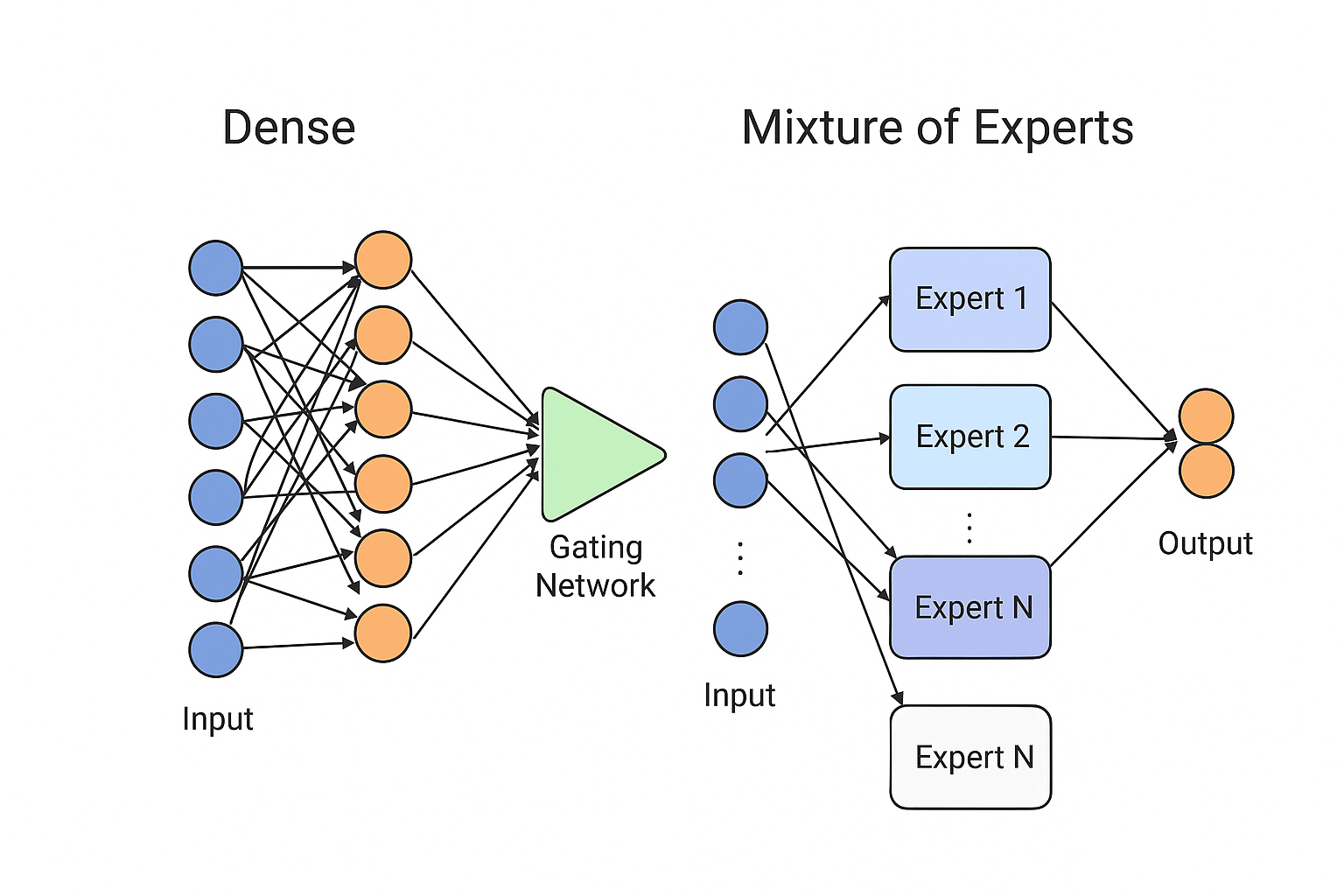
Neural Network vs. MoE Comparison
Chroma DB advantages vs. using AWS alternatives?
It all begins with an idea.
ChromaDB Advantages
Simplicity and Developer Experience
Extremely easy to get started - can run locally with just a few lines of Python code
Minimal configuration required compared to setting up AWS services
Built specifically for AI/embedding workflows, not adapted from other use cases
Lightweight and fast for prototyping and development
Cost for Small-Medium Scale
Free and open-source for self-hosting
No AWS service fees for small workloads
Can run on your laptop or modest infrastructure
Portability
Runs anywhere: locally, on-premises, any cloud provider
Not locked into AWS ecosystem
Easy to move between environments (dev → staging → production)
Purpose-Built for LLM Applications
Designed from the ground up for embeddings and semantic search
Native integration with popular embedding models
Optimized API for RAG (Retrieval Augmented Generation) patterns
Active community focused on AI/LLM use cases
Metadata Filtering
Sophisticated filtering capabilities on metadata alongside vector search
More flexible than some AWS solutions for complex queries
When AWS Solutions Win
Enterprise Scale & Reliability
AWS managed services handle massive scale automatically
Built-in redundancy, backups, monitoring
SLAs and enterprise support
AWS Ecosystem Integration
Native integration with Bedrock, SageMaker, Lambda, etc.
Unified IAM, VPC, and security controls
Single billing and compliance framework
Existing Infrastructure
If you're already heavily invested in AWS, staying native reduces complexity
Easier compliance if you need everything in AWS
Bottom Line
ChromaDB is ideal for:
Rapid prototyping and experimentation
Small to medium applications
Teams wanting simplicity and portability
Projects where avoiding cloud lock-in matters
AWS solutions are better for:
Enterprise-scale production deployments
Organizations already standardized on AWS
Cases requiring tight AWS service integration
Strict compliance requirements within AWS