
S3 bucket data poisoning attacks against vector databases - RAG data poisoning
A very relevant security issue for RAG pipelines involves data poisoning through misconfigured cloud storage, especially when knowledge bases are built from files stored in services like Amazon S3. Enterprise RAG systems automatically ingest documents from internal S3 buckets, Git repositories, or shared storage and then convert those documents into embeddings stored in a vector database. If an attacker can insert malicious content into that ingestion pipeline, the AI system may unknowingly incorporate it into its knowledge base.
This creates what security researchers call RAG data poisoning. Instead of attacking the model directly, the attacker injects malicious instructions into the documents being indexed. When those documents are retrieved during inference, the instructions appear inside the LLM’s context window and influence the model’s behavior. For example, a poisoned document might contain hidden text instructing the model to ignore previous instructions or leak sensitive configuration data. Because RAG systems trust retrieved documents as authoritative context, the model may follow these instructions unless guardrails are implemented.
A simplified attack path might look like this:
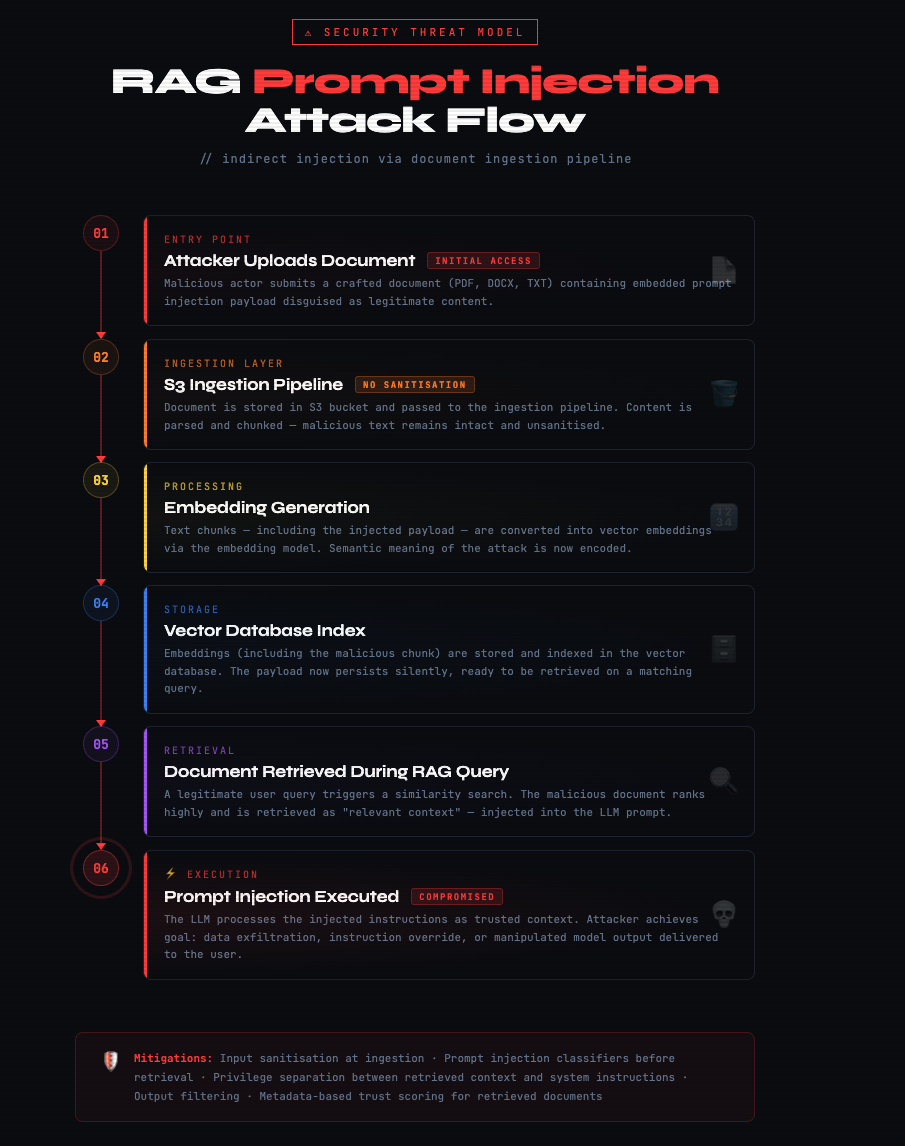
In practice, the attack does not require direct access to the AI system itself. The attacker only needs the ability to modify a document source that feeds the RAG pipeline—such as a shared S3 bucket, knowledge base repository, or document management system. If ingestion pipelines automatically index new content without validation, poisoned documents can silently enter the system and influence downstream responses.
This risk has become more visible as organizations deploy enterprise AI copilots that rely heavily on document retrieval. If those copilots index internal documentation, Slack exports, customer support tickets, or uploaded files, an attacker could hide instructions in documents that trigger unexpected model behavior during retrieval. The result may include misleading answers, data leakage, or attempts to call external tools with attacker-controlled inputs.
To mitigate these risks, AI engineering teams increasingly add verification layers around retrieval pipelines. Common defenses include document sanitization before indexing, content trust policies for ingestion sources, retrieval filtering to detect prompt injection patterns, and post-generation verification models that validate whether an answer is grounded in trusted sources. These controls transform the RAG pipeline from a simple retrieval system into a secure knowledge processing pipeline with validation and governance checkpoints.
This example highlights a broader lesson for modern AI architectures: security vulnerabilities increasingly arise in the surrounding infrastructure rather than the model itself. As organizations integrate LLMs with storage systems, APIs, and knowledge bases, protecting the integrity of data pipelines becomes just as important as protecting the models that consume them.