
Designing an Agentic RAG API: What the Response Actually Tells You - Part Two: From Model Responses to Document-Grounded Answers: Extending an Agentic RAG API
In Part One, we looked at what an Agentic RAG API response tells a client—and what it does not. There is another important distinction: making documents available on a platform is not the same as ensuring that a particular API request uses them to answer a question. For applications that rely on internal knowledge, policies, technical documentation, or customer records, the connection between a request and its supporting evidence is an essential part of the API design.
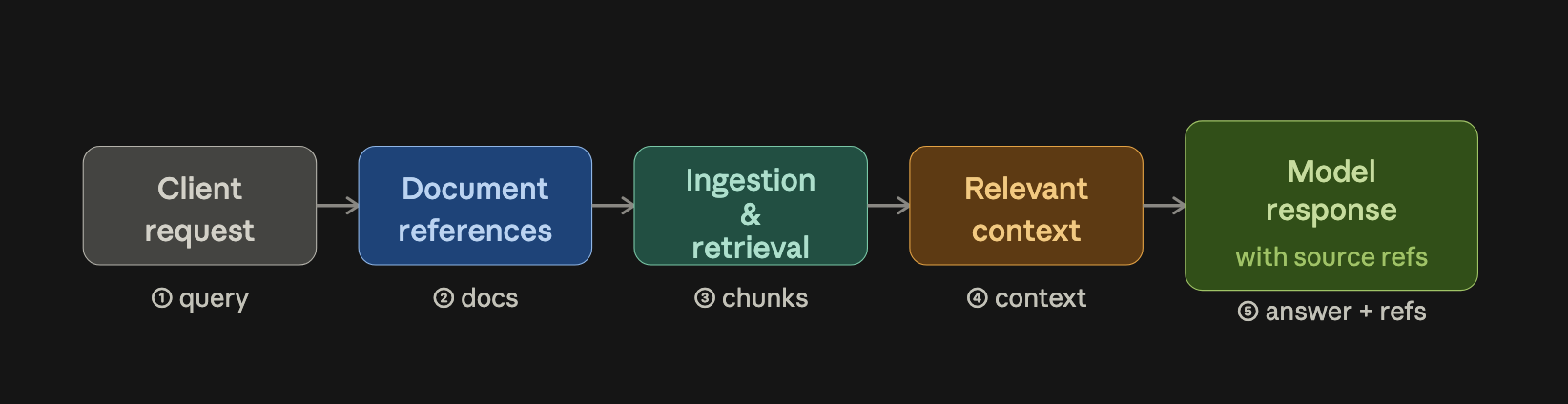
API flow design consideration for Agent RAG
A natural next step is to make document selection explicit. Rather than relying only on a model ID and a knowledge-base ID, an API could allow a client to reference specific documents or a managed collection of documents. Those documents might be stored in an object store such as Amazon S3, while the platform manages their ingestion, indexing, and retrieval. The important part is that the API defines how document references become searchable knowledge—not simply where the files reside.
For example, a future API design might allow a client to identify a document collection alongside its question. The platform could then retrieve relevant passages and provide them as context to the selected model. This would make the intended knowledge source explicit and create a clearer path from the original documents to the generated answer. This is a proposed extension, not a capability demonstrated by the current /v1/chat endpoint.
There are several implementation details behind this seemingly simple change. Documents need stable identifiers, ingestion and indexing status, access controls, and a way to handle updates or removal. The retrieval stage must select relevant material, and the application should ideally be able to identify which sources supported the answer. A reference to a document alone does not guarantee that it was retrieved, used by the model, or sufficient to answer the question.
The broader design principle is that model access and knowledge access are separate responsibilities. Selecting a model determines which model generates a response; connecting a request to a knowledge source determines what evidence can inform it. An Agentic RAG API should make both responsibilities explicit and predictable. That is a practical step toward applications that are not only capable of generating answers, but can also explain where those answers came from.